I Switched to the Symfonisk Bookshelf and Here is What Happened
Introduction
The Symfonisk Bookshelf — the product of a collaboration between IKEA and Sonos — arrived with a promise: an affordable entry into the Sonos ecosystem that doubles as a piece of furniture. Readers considering a compact, design-forward speaker for everyday listening, multi-room setups, or discreet shelf integration often ask whether it lives up to expectations. This article examines what happened when a reviewer moved from a small traditional bookshelf speaker and a Bluetooth routine to the Symfonisk Bookshelf. The review keeps an editorial, third-person perspective, concentrating on real-world use cases, typical buyer concerns, and practical outcomes.
Overview: What the Symfonisk Bookshelf Is (and Isn’t)
At its core, the Symfonisk Bookshelf is a networked speaker that integrates with the Sonos platform. It is designed to be compact, affordable, and flexible in placement: it can sit on a desk or shelf, or be used as a modest display shelf itself in some configurations. It is not a smart display or a voice‑forward device — it is a speaker intended to deliver music reliably, participate in multi-room systems, and offer solid value for buyers who prioritize ecosystem compatibility and simple, tidy design.
Detailed Product Review and Analysis
Design and Build
The Symfonisk Bookshelf is intentionally utilitarian, favoring a neutral aesthetic that fits many interiors. The cabinet is compact and lightweight enough to sit on a nightstand or small shelf, yet dense enough to avoid feeling plasticky. Its fabric cover and matte body make it unobtrusive; the design language is closer to furniture than to flashy audio gear. This makes it well-suited for living rooms where minimal visual impact matters or for bedrooms and kitchens where a low-profile speaker is preferable.
Setup and Usability
One of the Symfonisk’s strongest real-world advantages is the Sonos setup experience. The Sonos app guides users through network integration, naming rooms, and grouping speakers for synchronized listening. For someone transitioning from single‑room Bluetooth speakers, the first notable difference is the move from device-bound playback to network-based streaming: the speaker pulls music from services via the network, rather than relying on phone-to-speaker pairing. In daily use this results in fewer interruptions from phone calls and better multi-user control in households where multiple people want to play music.
Sound Quality and Performance
Sound can be subjective, but in practical terms the Symfonisk Bookshelf aims for a balanced, mid-forward presentation. Vocals and acoustic instruments come through clearly, which makes it a pleasant choice for podcasts, folk, jazz, and vocal-heavy playlists. Because of its compact enclosure, bass extension is limited relative to larger stand-alone speakers — low frequencies are present but not authoritative. For listeners who frequently demand deep, room-filling bass for electronic or orchestral music, pairing the Symfonisk with a separate subwoofer or choosing a larger Sonos product for the main zone will produce a more satisfying result.
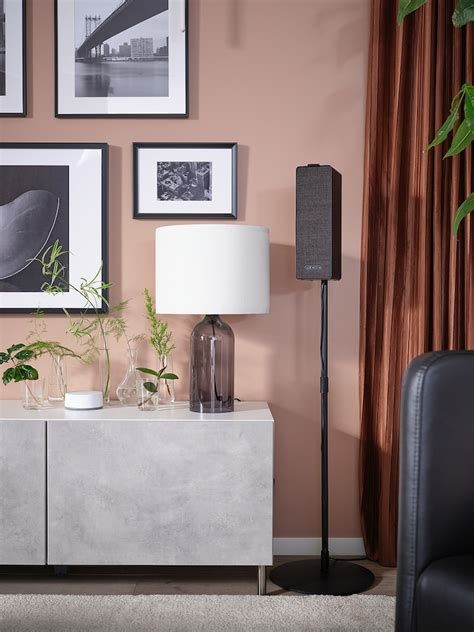
At moderate listening levels the speaker remains clean and composed. At higher volumes, the small cabinet shows its limits: distortion can appear when pushed very loud, and the soundstage narrows. In typical household settings — kitchens, bedrooms, small living rooms, and office desks — the Symfonisk delivers excellent clarity and a useful sense of scale.
Integration with Ecosystem and Services
For buyers who care about streaming compatibility, the Symfonisk benefits from Sonos’ broad service support: Spotify, Apple Music, Tidal, Amazon Music, and many others are available through the Sonos app and platform. Multi-room grouping and synchronization perform reliably, which is a major advantage for users who want whole-house audio without juggling multiple Bluetooth connections. The Symfonisk can also serve as a surround speaker when paired with supported Sonos soundbars, which gives it added flexibility as part of a home theater ensemble.
Connectivity and Control
Network playback is the primary mode: music is streamed directly by the speaker via the local Wi‑Fi network, which means the controlling device acts as a remote rather than a direct audio source. Local control is straightforward through the Sonos app; physical touch controls on the speaker are typically limited to basic playback and volume functions. Voice assistants are not built into the Symfonisk bookshelf (it lacks onboard microphones), but voice control can still be achieved indirectly when integrated into a Sonos system that includes a voice-enabled Sonos device or a separate smart speaker.
Shop the latest Audio & Headphones picks on Amazon.
Browse Now →Placement and Real-World Use Cases
The Symfonisk shines in several common scenarios:
- Kitchen and Dining Areas: Durable, compact, and easy to wipe down, it fits on counters, open shelving, or mounted near the prep area to provide background music while cooking.
- Bedrooms and Home Offices: Its neutral sound signature and unobtrusive design make it an excellent bedside or desk speaker for focus playlists, podcasts, and video audio enhancement.
- Multi-Room Systems: For apartments or houses putting together a Sonos-based multi-room system on a budget, the Symfonisk is an affordable node that synchronizes with larger Sonos speakers for consistent coverage.
- Home Theater Surrounds: When used as rear surrounds with a Sonos soundbar, it provides improved ambience and discrete rear imaging without disrupting room décor.
Pros & Cons
- Pros
- Good value for the Sonos ecosystem — entry point to multi-room audio.
- Neutral, furniture-friendly design with compact footprint.
- Clear mids and vocals make it excellent for dialogue, podcasts, and acoustic music.
- Reliable Sonos app and stable multi-room synchronization.
- Flexible placement; can be used as part of a larger Sonos system or as a surround speaker.
- Cons
- Bass output is limited by the small enclosure; not ideal as a sole speaker for bass-heavy music at high volumes.
- No onboard voice assistant — requires an additional device for hands-free voice control.
- Some advanced audiophile features found on dedicated hi‑fi speakers (such as large passive radiators or deep low-end tuning) are absent.
- Design choices that prioritize integration and price mean it may not satisfy listeners who want a bold, characterful sonic signature.
Comparison
A comparison helps buyers weigh the Symfonisk Bookshelf against common alternatives. The table below highlights key differences in a concise format to assist in decision-making.
| Feature | Symfonisk Bookshelf | Sonos One (typical Sonos compact speaker) | Typical Bluetooth Bookshelf Speaker |
|---|---|---|---|
| Primary Connectivity | Wi‑Fi / network streaming via Sonos | Wi‑Fi / Sonos ecosystem | Bluetooth (some offer Wi‑Fi) |
| Voice Assistant | No built-in mic (no onboard assistant) | Yes (mic and voice assistant support) | Usually no, unless smart speaker |
| Multi-room | Yes — Sonos grouping | Yes — Sonos grouping | Limited — depends on brand |
| Bass/Low-end | Modest — clear mids, limited deep bass | Balanced for small rooms, limited deep bass | Varies widely; some offer deep bass |
| Design | Furniture-forward, subtle | Speaker-forward, premium finish | Varied — from retro to modern |
| Expandability | High — integrates with Sonos ecosystem | High — integrates with Sonos ecosystem | Often limited to same-brand features |
| Price Position | Value-oriented entry into Sonos | Mid to premium small speaker | Ranges from budget to high-end |
Buying Guide: What to Consider Before Switching
For prospective buyers weighing the Symfonisk Bookshelf against alternatives, the following points reflect what typical buyers care about and how the speaker performs in those areas.
1. Intended Use Case
Decide what role the speaker will play. If the priority is background music in kitchens and bedrooms or adding inexpensive nodes to a Sonos multi-room system, the Symfonisk is highly appropriate. If the goal is the main front-left/right speakers for a large living room or a dedicated two-channel hi‑fi setup, buyers should compare specifications and audition larger speakers or consider adding a subwoofer to the Symfonisk.
2. Ecosystem and Expandability
One of the main reasons to pick the Symfonisk is the Sonos ecosystem. Buyers who value reliable multi-room synchronization, frequent firmware updates, strong streaming-service support, and the ability to later add soundbars or a subwoofer will find the Symfonisk an easy on-ramp. If one prefers a stand-alone Bluetooth speaker that doesn't depend on an ecosystem, other options might be simpler.
3. Placement and Aesthetics
Consider where the speaker will live. The Symfonisk was designed to blend into home furnishings, which benefits buyers who are conscious of interior design. Its compact size makes it more versatile than a bulky floorstanding speaker, but that compactness imposes limits on maximum volume and low-frequency performance.
4. Sound Preferences
Listeners who prefer tight, detailed mids and vocals will likely be pleased. Those who prioritize thunderous bass or a warm colored sound signature may want to audition alternatives or plan for a subwoofer. It is always advisable to test the speaker with the music genres most frequently played in the household.
Find top-rated Audio & Headphones products at great prices.
Browse Now →5. Control and Convenience
Understand how the Sonos app changes the listening workflow. The Sonos approach removes the phone-as-source model in favor of network-based streaming, which is convenient for households where multiple members want to queue music independently. However, the absence of a built-in voice assistant means hands-free voice control requires an additional voice-enabled device on the network.
6. Budget and Value
The Symfonisk Bookshelf tends to be priced below comparable Sonos speakers while offering many of the same ecosystem features. For buyers seeking value and a clear path to expand into a multi-room Sonos setup, the Symfonisk often represents a compelling compromise between cost and functionality.
7. Futureproofing and Software Updates
Sonos is known for long-term software support relative to many consumer audio brands. Buyers who prioritize longevity and continued feature additions should factor the platform’s history of firmware updates into their decision. That said, users should confirm current feature sets (such as AirPlay compatibility, Trueplay tuning, or other capabilities) with the most recent specifications at the time of purchase.
Real-World Scenarios: What Happened After the Switch
In everyday life, the switch to a Symfonisk Bookshelf typically produces a few predictable outcomes:
- Cleaner listening experience for background tasks: Acoustic music, podcasts, and talk radio become clearer and easier to follow than on compact Bluetooth speakers tied to phones.
- Less distraction from phone activity: Because playback streams directly from the network, incoming calls and notifications no longer interrupt music playback from other household devices.
- Rapid expansion without complicated pairing: Adding another Symfonisk or other Sonos speaker to create synchronized zones is straightforward and reliable compared with juggling multiple Bluetooth pairings.
- Need for additional equipment for deep bass: Households that frequently listen to low-frequency-heavy music will notice the speaker’s limitations and may add a subwoofer or a larger Sonos speaker later on.
Conclusion
The Symfonisk Bookshelf offers a pragmatic, design-friendly, and affordable gateway into the Sonos world. For people who value multi-room control, clean mids and vocals, and a speaker that blends into home décor, the Symfonisk delivers tangible, everyday benefits. It is not a solution for listeners who demand powerful, low-frequency performance from a single compact speaker or who require an integrated voice assistant. Rather, it excels as an unobtrusive, high-utility node in a broader Sonos setup or as a primary compact speaker for smaller spaces.
Switching to the Symfonisk Bookshelf typically means trading raw low-end authority for clarity, convenience, and ecosystem flexibility. For many buyers—particularly those building a multi-room system or seeking a tidy, furniture-minded speaker for ordinary listening—the result is a practical and satisfying upgrade.